
Original Author: PHOTONSTREAM | Source: PHOTONSTREAM
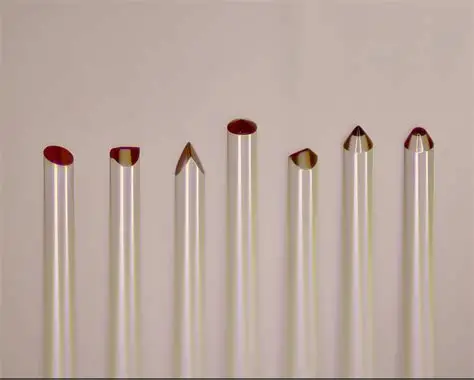
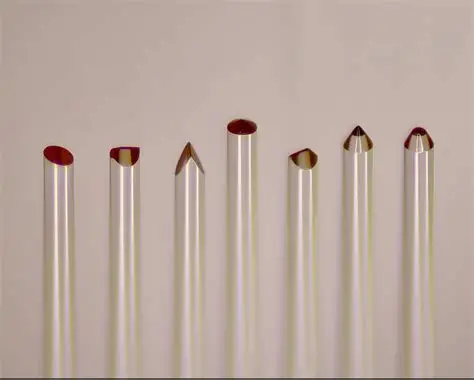
The role of lensed fiber is to act as a light path change or mode conversion in an optical fiber or optical system. There are different requirements for lensed fibers in different applications. This article mainly focuses on different types of lensed fiber, respectively, to introduce their functions and applications.
Beveled lensed fiber
Beveled lensed fiber is mainly divided into two categories. One type has a bevel angle of 6°~10°, which is used to prevent the light reflected from the surface of the fiber from causing interference or damage when returning. Another type of bevel angle of 40 ° ~ 50 ° or even greater, can make more light into the fiber, mainly used in fiber laser, fiber optic communications, fiber optic sensing and other fields.
Wedge Lensed Fiber
Most of the wedge-shaped lensed fibers by our lensed fiber manufacturers are combined for optical coupling. Common combinations of lensed fibers include microcolumnar lensed fibers made with a wedge-shaped lensed fiber front end, tetragonal lensed fibers, and oblique wedge-shaped lensed fibers. We collectively refer to them as wedge lensws fibers.
Spherical Lensed Fiber
Spherical lensed fibers are used in optical coupling, biology, medicine, sensing and many other fields. For example, a beveled lens on a spherical lensed fiber can be used for OCT, a diagnostic imaging technology that has developed rapidly in recent years.
Conical Lensed Fiber
Conical lensed fiber expands the numerical aperture of the fiber and increases the light receiving capacity, so it is very suitable for coupling with SLD lasers or VCSELs, etc. that have a circular or nearly circular cross-section of the output light east. High-precision conical lensed fibers are also used for medical laser microsurgery systems.
FAQs about lensed fiber array
How do lensed fibers improve laser beam delivery?
In laser beam delivery, lensed fibers help focus or shape the laser beam to the desired specifications. This is particularly important in applications such as laser surgery, laser engraving, and industrial cutting, where precise control of the laser spot size and intensity is crucial.
Are lensed fibers compatible with existing optical systems?
Yes, lensed fibers can be integrated with most existing optical systems, provided that the fiber and system specifications match. It’s important to ensure that the lens type, fiber diameter, and coupling techniques are compatible with the system to achieve optimal performance.
What factors should I consider when selecting a lensed fiber for my application?
When choosing the right lensed fiber, consider the following factors:
- Application requirements: Whether you need a focused beam, broad collimation, or specific beam shaping.
- Wavelength: The fiber should be compatible with the light wavelength used in your system.
- Fiber type: Single-mode or multi-mode fibers, depending on your application’s distance and precision requirements.
- Performance specifications: The optical efficiency, loss characteristics, and coupling efficiency of the lensed fiber.
How do lensed fibers impact the performance of fiber optic systems?
Lensed fibers significantly enhance the performance of fiber optic systems by reducing signal loss, improving beam collimation, and providing better light management in various optical tasks. This leads to higher efficiency, better reliability, and greater system performance in both communication and industrial applications.
Original Author: PHOTONSTREAM | Source: PHOTONSTREAM